Today, I do the day from bed. I left it this morning, while only momentarily, to walk the aisles of Bunnings and retrieve a pork belly banh mi from the most esteemed vendor in the area, whose name I will disclose for they are getting too popular for my liking. I even had a shower to then return to the cozy flat comfort of the bed’s crushed linen. Fifty days into isolation and the dwelling of home, work, play, eat, sleep, and socialise have been convoluted and crushed into a compact, singular one. I am sprawled here among books, papers, highlighters, teacups, crumbs of popcorn. My head is where my sleeping feet spend every evening so I am able to gaze out the large west-facing windows. The day is pale grey and the wind bends the structures of the bare trees that I can see; gusts of it shuffle the windows in their frames making this body in this bed feel extra content.
I feel very much within my natural milieu lying in the center of all the objects, blankets, and wall hangings I have gone out of my way to purchase and hold onto over the years. I understand that the human is nothing but a quilt of their acquisitions and imagine that this is what it must feel like inside my womb. Several blocks away a crane swivels on its axis, there is a man in a glass box. Apparently, they make excellent money. I, too, would like to make excellent money and wonder how many female crane operators there are in the world. The crane out my window is yellow, sluggish, and deliberate much like a giraffe. Outside my window, beyond the sill, every day is nothing more than a drama of signs.
In certain positions, like collecting my dropped pen from the floor, a headache suggests but fails to impress any actual pain. I fill up a large pot of English breakfast tea and see there are four empty wine bottles that were not there yesterday, on top of the bottles rest two empty pizza boxes, of which I cannot recall the flavors. In my inebriated state last night I remember sitting in the big blue chair looking at the aubergine vase that sits on top of the record player. T was putting on a record and looked extra tall from where I was sitting. The aubergine vase was holding the flowers given to me by him in the midst of the predicament, the aubergine vase full of a thousand terrible s-o-r-r-y-s. I was later told Sampa The Great uses this company for her stage sets. Though, when I later scrolled her Instagram I still couldn’t bring myself to like them. I remember thinking the flowers seem to be lasting forever and manifesting that they just die already so they can stop reminding of the predicament. If every day is nothing more than a drama of signs then I am nothing more than a patchwork of reaction.
Last night we hosted a friend; the very friend that introduced T and I four years ago. We love her. She had never been to our current home and in the hours leading up to her coming over T and I exemplified an acute awareness of this. He put things away, created places for homeless items, arranged to then rearrange, sweep, wipe, and straighten. I cleaned the kitchen, took out the bins, prepared snacky things. Finally, he walked around the place with a stick of burning sandalwood to clear away bad spirits and the lingering smell of two humans confined to isolation, which is mostly that of a very full washing basket and a lot of sex. Rachel Cusk writes, like a body, the home is something to be looked at and lived in. She confesses that it is a duality that in neither case she has managed to reconcile. I am interested in this opposition of seeming and being that T and I concerned ourselves with as we went about preparing the house to be looked at and sat in as if our house was an extension of our very beings. As if the angle of the vases reflected some quality of our body interior.
Growing up I would often observe my mother become anxious and irrational in the lead up to guests coming over. It seemed the domestic space of our house could easily become the cause of her social and cultural anxiety. She is not what one would conventionally deem tidy. Also, we like to tease that she is a hoarder. We never had enough space or order for all the many things our six bodies liked to acquire. I wonder if the private space of the home really is our body interior, at least for the female homemaker, where the inviting and hosting of guests means she is subject to scrutiny and retribution or if the female homemaker succeeded in her homemaking, praise, even envy. Isn’t this what we are all after anyway? My mother’s anxiety was isolated to the tidiness and cleanliness of our living spaces, rather than demonstrating evidence of wealth, culture, or some sort of autobiography of our family.
Yesterday evening, as I moved around the house shifting things and losing time over the way in which the prosciutto piled and draped on the wooden chopping board, I was made to see just how enslaved I can be to the aestheticization of everyday life. This aestheticization is the very reason I deleted Instagram two years ago. I am a romanticist, sometimes hopelessly so, which manifests in the aesthetics of things, mantlepieces, clothing, table settings. Sometimes when I look at something to my liking I am not just pleased; I feel, instead, overwhelmed by a tingling sensation so much so I don’t know what to do with myself. It’s almost painful. A euphoric kind of appreciation I have only observed one other person genuinely exhibit, perhaps to a greater extent than myself, and that person is Sicilian Nic. Cusk speaks about the mute power of objects being immensurable. It is no secret to those of us who know us at all that T and I like to buy nice ornamental things. Naturally, we are homemakers. I am drawn to lamps, jugs, and ceramic vessels that hold smaller practical things while he is inclined to collect artworks, plants, and vases. There exists a certain poetics to the living room, the bedroom, and, of course, the kitchen. Virginia Woolf writes in her diary about the occasion of her buying a new chest of drawers; she writes of her having to leave her desk every half an hour to marvel at its material beauty. There are two glass jugs that never fail to arouse me, the handle and body of the jugs are different colours and when standing together against a plain background the four colours do something to my body. In moments of looking at the jugs, I entertain that perfection does, in fact, exist.
These objects and their obvious materiality are not bound by a temporal limit or the space they take up because these objects are the very matter with which I am allowed to insert narrative; a vista beyond where the former and future, the offing and ideal self dwell. I find the ledge, mantel, or shelf provides a stately platform for the display of self. This morning T, full of the practicalities and bother I am not, assembled not one but two shelves in our home. This was the reason for the journey to Bunnings. I did not think this was something we required and complained nearly one hundred percent of the time. Though, as I watched them being screwed into the wall I couldn’t -still can’t- believe we had gone without them for so long.
I recall the day before the government enforced stage three restrictions in Victoria. T and I went to Uniqlo to retrieve some much-needed basics. He purchased a green knit jumper from a tall pile and after wearing it all the way home on the train and over dinner that evening the jumper was completely affixed to his character. The green knit was all of a sudden congruent with his person. To recall him without the jumper, and vise versa, would now be a faux pas. The jumper was no longer one out of the million green jumpers Uniqlo manufactured in that size. I skipped the basics that day. Instead, I purchased a special garment from a different store, which, owing to the lockdown restrictions, I have still not had the opportunity to wear. It hangs in my wardrobe among my other worn clothes, uncreased, with all the tags on. The garment is waiting to have a narrative inserted into it. In this way, it still belongs to the store. I often wonder and discomfort over how many people own the things I deem mine. Three years ago I ordered a jacket from a Spanish brand. I had deliberated over the bold orange or the light green for weeks to finally settle on the orange. It was highly anticipated and when it arrived I was overly satisfied. I have since had many great days and evenings wearing this jacket. Though, I will never forget the day when I saw an acquaintance in the exact same jacket. I was overcome by a defensive kind of anger. I’ve never looked at the jacket the same.
Then there are the objects that you cannot redeem an affinity for. Objects you acquired with an irrational sense of urgency, the kind of urgency that is the byproduct of a large paycheck, gambling that went right or, in our case, the byproduct of government assistance, which lands in our lap every other Monday. Sometimes I will look at an object, an item of clothing, maybe come across a ring deep in a box to wonder what had I been thinking at the time of purchasing. Who, I wonder, managed to hijack my judgment so. I hold onto it for that day I might require it in the future. Though, this day is yet to arrive. Clothing is often the most explicit example of the evolution of the self; photos that make you say out loud, god make it stop. Roland Barthes writes… and then one day, realising the function of the drawer is to ease, to acclimate the death of objects by causing them to pass through a sort of pious site, a dusty chapel where, in the guise of keeping them alive, we allow them a decent interval of dim agony, I think about government payments, so generous and regular that T and now anticipate their arrival. The days before, of, and after are characterised by this very irrational urgency to acquire. T says we are supporting local businesses, injecting money into the economy. Though, I do wonder just how much all of this may be warping my perception of monetary value. I also wonder how much of it will end up drawered in six months’ time.
Last night the friend told us how very much she loved the space we have created, it’s so you, she said. I pondered this, thinking about what comes first: the chicken or the egg: me or the object? These rooms, back in February before we made them our own, were blank space, completely vacant of meaning. We inserted ourselves by way of objects, furniture, wall hangings and now it reflects us, apparently. The poetics of the domestic establishment allows one to exhibit one’s inner unordinary; what one desires but cannot quite articulate. Surrounded by all the objects the way I am now, I wonder just how much they work to accomplish this identity.
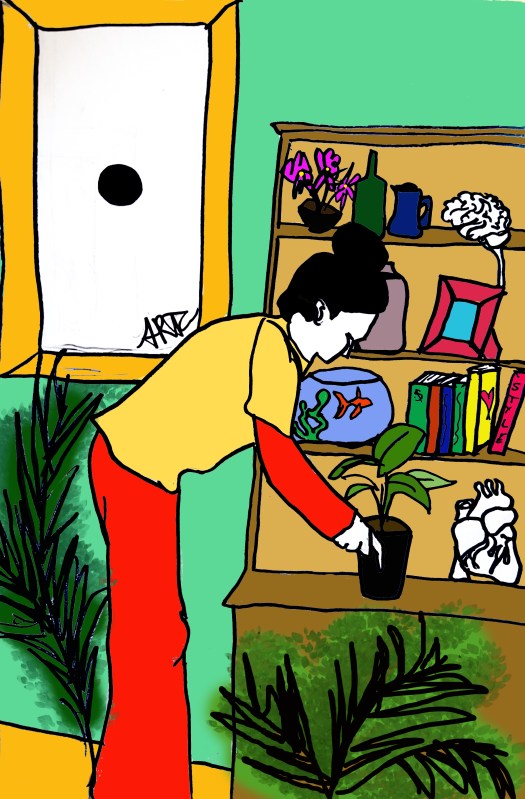
Illustration by Sophie Dickinson @sophie_dickinson
 Yellow Days