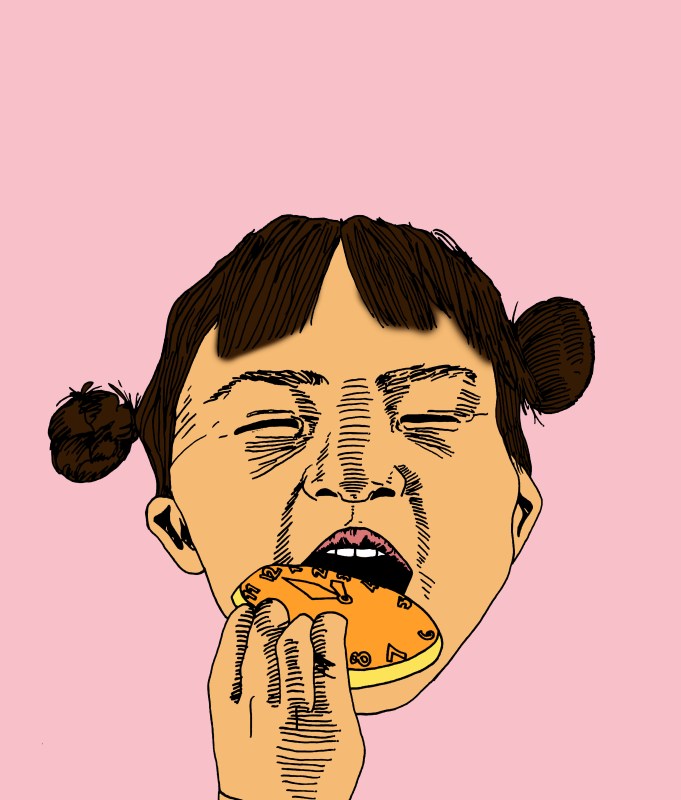
How is it already April, people all around me exclaim. Except this time they are not merely observing the pace of time but saying it in such a way that when they reach the April part of the sentence, I can feel their voice exert an unsure force on the air around us, as if this sentence is an attempt to halt time where it no longer is.
Where time is not: in my lap.
Where time is: on other people’s walls, wrists, dashboards.
The window above my bed is as open as it can be. I watch a woman leave the restaurant on the corner and walk to her car, which is parked in front of the deli. She is right beneath me when she says, God! I’m just so full, as if it will not pass.
Meredith, my psychology lecturer, has prefaced our unit on memory with a quote from Tennesse Williams, in which Tennessee asks,
“Has it ever struck you that life is all memory, except for the one present moment that goes by you so quick you hardly catch it going?”
Yes, Tennessee, I imagine saying, it has struck me. In fact, sometimes I wish it would strike me a little less.
Clock, mortar and pestle, measuring cup, vase, radio, voice recorder, the list reads. At the opportunity shop, I browse these categories with more rigour than I thought I had for four in the afternoon on a Tuesday. A clock would be nice, I think.
There is a tall man arguing with the woman behind the register. He wants his coffee table back because he didn’t realise how much it is worth. She says it is in someone else’s home now and she doesn’t know who that someone is. The man looks up and around the store to then finally rest his gaze on me, as if I am his prime suspect.
The clocks are all Ikea-modern. I decide I’ve been in here too long to leave empty handed and buy two yellow and red enamel vessels appropriate for things that already have a place.
The same two men walk through the deli’s kitchen every Wednesday at fifteen minutes past midday. They sit down at the same small table and order the same two sandwiches and same two beers. Each time they do this I am reminded of the fact that a week has passed by me.
I say this to Nico over our weekly Wednesday knock off. He is having an amaro which is amber like the five in the afternoon autumn light collected in my glass.
It strikes me most when looking at a photograph, any photograph, taken at a scene in which I was present.
I was there, I think.
I can travel back there, I think.
But really I am here now, not there.
How can this be?
What the photograph reproduces to infinity has occurred only once: the photograph mechanically repeats what could never be repeated existentially, Roland Barthes wrote.
Daisy is talking about the black hole that is her Instagram feed. Time envelopes itself here. Sometimes I’m reading and I’m right there mid sentence, mid paragraph and then I blink and I’m looking at pinstripe loungewear I really can’t afford, Daisy says with a sigh.
Apple suggests that memory and photograph are synonymous terms. A suggested ‘memory’ appears on my phone once a day. Do you ever look at photos of your ex, I ask a friend. They put down the grater and the block of cheese so they can look me in the eye to tell me this is not a productive activity. I start dragging my finger through all the memories but the friend snatches the phone from me. No you can’t delete them, the friend says, that would be unhealthy.
Two days ago I took a photo of someone sitting at my dining room table. The yellow lilies were all closed in the photo. Now five of them are open. Every time I ascend the stairs a new one has bloomed. In three days time they will be droopy and sad and I will throw them out. I will only be able to experience them through the photo on my phone.
Barthes wrote about the photograph as a perverse confusion between two concepts: the Real and the Live: by attesting that the object has been real, the photograph surreptitiously induces belief that it is alive, because of that delusion, which makes us attribute to Reality an absolute superior, somehow eternal value; but by shifting this reality to the past (‘this-has-been’), the photograph suggests that it is already dead.
A new friend hands me an advance reading copy of a book. It’s digestible, he says after hearing about my reason for re-reading an old favourite. The following evening I open it. The author has prefaced the book with a quote by Italo Svevo,
Whenever my surroundings change I feel enormously sad. This is especially true if the place I leave behind is linked to memories, grief or happiness. It’s the change itself that unsettles me, the same way liquid in a jar turns cloudy when you shake it.
I’m not sure if I am allowed to underline the advance reading copy and opt to photograph it instead.
Peek forward to module seven, which corresponds with the week beginning on the 28th of April. We will be covering various kinds of amnesia including the motivated, deliberate kind. There are case studies on trauma and delusion. One is titled The Human as Expert; a Study of Denial and I remember why I am embarked on this degree in the first place.
Memories are not three dimensional, Meredith says, nor are they tangible. They are just clusters of neural pathways stored in our brain. Meredith offers the task of remembering our first bedroom, specifically: what this bedroom looked like and which way the bed faced. I don’t need to close my eyes to pull it up. She tells us we have called on one particular neural configuration in the visuospatial sketchpad of our visual cortex.
Now, Meredith says, I want you to travel to your amygdala in order to locate your feelings about this bedroom. I close my eyes imagining my brain like the flight path on the small screen on the back of someone’s chair.
For me, Barthes wrote, the noise of time is not sad: I love bells, clocks, watches, he wrote.
The unreliability of memory, I remember Georgie’s exegetically essay being on. It was the last thing we had to submit in our writing degree. She said it was something that burdened her auto-fictive practice, like a figure over the back of her chair. Did it really occur this way? the figure would whisper to her.
Tomorrow we will roll back our clocks, the ABC newsapp on my phone says. What this means for you, a sub-line underneath this reads.
My sister brings a different batch of hot-cross buns into the deli for us on each day of the easter holiday. These ones are light and full of fruit compared to yesterday’s sourdough kind. It is Easter Saturday and Daisy has a UTI. This time one year ago things were disparate to the way things are now. My sister didn’t know the baby crying in her arms was coming. None of us knew anything.
I wake at six am, which is really seven. There is voice memo from my sister telling me she is t minus fifteen away. I roll out of bed and mumble something back. This is the way we communicate now, like children with walky-talkies. Everything is intoned the way it is supposed to be. With the click of the button, I can replay the conversations. You can hear anticipation in her voice and fatigue in my own. It’s like a photograph for the blind.
Today’s memory is of a boy I once loved on a bike. My finger hovers over the delete button. An item of memory decays if we do not attempt to access it, the pathways weaken until they are no longer there. Though, Meredith warns, for reasons we are still trying to figure out, there are memories so significant they are immune to this decay no matter how infrequently we visit them.
Certain perfumes remind me of certain people. I am often incompetent at naming who these people are. The perfumes stop me in my tracks and leave me disturbed for reasons I cannot say. According to Bjork and Bjork’s New Theory of Disuse, once items are stored in our -unlimited- long term memory they do not leave. It is our ability to recall them that decays, much like all the garments at the dry cleaning whose owners have forgotten to pick them up.
She’s always on edge. I’m not sure why. I think she is burdened by the passage of time, the narrator of the book I am reading says of her mother.
It feels like Christmas morning, my sister says. It’s not, I say. It could be, she says. We walk around the market slowly, letting the balls of our heels roll on the concrete with each idle step. We visit different stores for different items we require until we’ve done them all. The fruit and vegetable shelves are like colourful clocks. The tomatoes are floury and seldom abundant. Asparagus is Mexican and expensive. Meanwhile, Heirloom pumpkins are on the way in, along with mushrooms and truffles and all the apples one can think of.
We’re living history, Dad said to me last week on the daybed under the jacaranda. Opposite the daybed was the elm, which has all of a sudden become a very established tree. We were about to sit up for Easter Lunch of pink lamb and the rest and I was contemplating what drink I would have to go.
I remember wanting the day to finish. I could feel a head cold presenting and I couldn’t un-mind the image of my crisp rosewater sheets waiting for me the way they were.
Now I’m here, five days later, with a cold and my sheets are no longer clean.
Time is only visible if you remain in the same place long enough. Though, even then you will struggle, Rebecca Solnit writes.
I’m washing dishes when a familiar red haired-man taps me on the shoulder. He’s been gone for two years, he says. He’s so happy that we are both still here. Daisy is behind me. I look for her face to see if she has felt the sting of these words. But she is surveying the fridge, contemplating what she will make for lunch.
In class we discuss the work of memory. According to my meaty textbook, it is the temporary storage and processing of information that can be used to solve problems, respond the the environmental demands and meet goals. Also known as, Meredith says lifting her hands into large air quotes, the present moment.
Does it bother you that the present moment is constantly expiring, a person in my tutorial asks. I look up but cannot find where the question came from because of the masks we are each being made to wear over our face. How are we not done with this by now?
In the hours after Sicilian Nic’s birthday, I do not believe it will pass. I’m never drinking again, I say. Daisy tells me to embrace it. She is standing above me swaying. I can’t access what it must be like to be in a state like her: one of clear head, good health. Soon enough, I fall asleep, the nausea dissolves and I wake up something different.
My cousin in anxious about turning forty. The whole of this year will be plagued by raw and unsure feelings in her body. Her mental health, while already fragile, could shatter like the amber glass at the bottom of the stairs I have been saying I will clean up. We discuss the idea of expiration; she tells me she has frozen her eggs. And I see time as being in her lap, or if not there then safe in a laboratory fridge.
What about the back door access(ness) of a moment? It has already left as you read this.
A friend is broken up with. I sit down to trawl over the last three months in my mind for my best advice. Time heals all wounds, I write then back space. This feeling will expire, I say, trust me. Do not see him, I add in caps lock. And do not look at photos. These memories are unproductive; they only aid retrieval, which inspires feelings of fondness and love. You will get nowhere this way.
Ethan and I meet for coffee. I mention something about ricotta gnocchi later and he asks, what time? In three hours, I say. That’s ages, he says and we embrace goodbye.
I eat my bowl of colourful soba noodles out the front of the Carlton community centre only to decide that autumn really is my favourite season. However, I would really like it if the trees could hold onto there leaves a little while longer. One crisp one falls into my empty bowl as I think this; it is brittle, the colour of terracotta.
Now Ethan is standing in my living room. The saucepan of water is coming to the boil. The sun is low like some exterior force dimming Monday. Something’s been bugging me lately. I ask Ethan what the deal with copyright is, specifically: do you think I can copy and paste a whole poem into this post?
I walk across the room for the latest issue of The Paris Review on my bedside table. Ethan tells me to open the window. As I do, I see the woman who was so full is back. I flick to page forty two, to where there is a poem by D.H. Tracy who has put all this down better than I know how.
This is it in parts (and without parts).
Inevitably,
sporadically (like clockwork,
unlike clockwork), something
goes thlunk into the pond of you,
Your contract/lease/tour/term was up. You moved across town.
The guests departed, or you got a diagnosis.
The new normal feels like fresh linen, a little,
even when bad. The new normal monkeys finically
with the sublives where you dream and mate and work; the new normal tweaks
the way you think about the future, light jazz, incarceration, and vegetable cream cheese;
about the toupee of dust on the top of the fridge (care, don’t care),
about fixing things or tossing them,
about the relative merits of an enchanted forest and Rantoul in broad daylight.
Striving and coasting, hating and forgiving
for now. And you fall in with the rhythm of where you have to show up when.
sick of itself and determined to depart from its own pattern
and fade, like a firework, to be replaced by another,
like a firework. Replaced and replaced again.
I want to say there is still a cadence to this,
a normalcy of normals. But what if they ask, someday, What were things like?
 Yellow Days