So catch me up, the tattoo artist says. Her face collapses when I tell her about my ex being, well, my ex. The words don’t wobble like they did five months ago. Now they trip, superficial abrasions. The studio is how I remember it only today blue afternoon light is flooding in via the expanse of windows and mingling with the pink of the studio’s walls. The product is this transient, Wonka-purple. It was only one year ago that she inscribed each of us with a matching sketch. Now both of us walk around with two flowers in a vase along the radius of our forearm. She proposes a cover up and for a moment I think about this offer only to wag my head, no.
Em is making aioli when I walk in. There is a mobile phone pinned between her chin and shoulder, which is in one of those wallet cases bursting at the seems with all kinds of receipts. I imagine the receipts are for things like Special K and pretzels and Malteser chocolate slabs and fruit free muesli and fluffy pork buns one stores in their freezer. A sensation rises in my body thinking about how we all possess different staples. I wave. She doesn’t acknowledge me. She’s on the phone to her partner discussing what they will have for their dinner later. Do you want peperonata or caprese with it, she asks. I too used to be preoccupied with dinner, over what I would cook. I do not miss this. Last week, I had an omelette because I could. It was delicious.
The 7.42 pm has been delayed, the automated woman tells us over the intercom. A man folds his newspaper in half and slaps it against the pole to my right. The sport section comes loose from this declaration of frustration. We all watch it, collected by a strong, cold wind, fly away. Seeing the man this way makes me reflect on my own temper. It seems any anger I used to possess has, for the most part, left my body. The man is dedicated to his mood and grows sterner as the numbers on the screen deplete, until the train arrives and he doesn’t stand aside for people to get off. I click play on Solange. There are cranes in the sky.
On the balcony at the housewarming of my former roommate, I am drinking wine out of a metal jug usually used for steaming milk. I am speaking to a young woman I used to be in a bookclub with for a short period of time. This woman has always intrigued me, both in her reserved, complex nature and her undeniable beauty. When it was her turn to pick a book, I recall she nominated One Hundred Years of Solitude by Gabriel Garcia Marquez. It is only now as I recall this that I recognise the title speaks to her character for this woman possesses a deep passion for solitude, which she tells me about while staring into the distance in a state of enchantment. Other people burden her, she explains. I nod. This woman is alone but not, as far as I can tell, lonely.
There is another thing the young woman on the balcony once confided in me and it is something I think about often. It was two years ago, at a music festival, when she shared with me details of a relationship she had with a boy I used to admire in school. She explained to me the awful and unproductive paranoia she fell into in this relationship. At the time of her telling me this, I had been with my ex for three and a half years and could identify with some of the states of mind she was naming. Though, in what was probably a mixture of pride and denial, I did not say this to her that day. Throughout twenty-twenty, the last year of our relationship, I thought of this exchange between us on the grass at the music festival several times, as if she was warning me of what was to come.
At the wine shop, I don’t deliberate for long, pick the more expensive bottle too. That was quick, Mum says. It is true to say I’ve been somewhat decisive lately. I attribute any newfound conviction to living alone and basing decisions on myself rather than some other. I ask her about her weekend while taking in the Specials board. There is an eye fillet, which sounds delicious but I had red meat yesterday evening. Mum embarks on a story, which is really a list of instances in which her guests frustrated her during their time away. I work through the specials by way of elimination until I arrive at the veal cotoletta. Congratulations by the way, Mum says.
Colourful plates fill the whites of the table. I take in the weight of the serrated knife, the way it glides through the crust of the cotoletta and the way a french fry feels between my teeth. I like the regulated curve of my plate and the low hum of other people catching up. There are specs of herbs in the cotoletta crust: dill, I believe. They look like the tiny chromosomes I learnt about in class earlier this morning when I was thinking about this dinner. We have twenty-two of them, chromosomes, plus two sex ones. Mum says to the waiter she couldn’t possibly have dessert. Neither, says my sister. I also pass, despite having room and desire, and I realise this is all very hereditary.
Day one of my new job. I prepare two eggs instead of one. In the hour leading up to twelve, I follow Daisy’s advice and practice saying all the heavy words of the industry . They don’t roll off the tongue. There are thirty two psychologists, all of whom specialise in different things. I will soon come to know most who phone me are seeking support for an eating disorder. My second call is a particularly distressed mother. She pleads with me for an emergency appointment. I hang up and call my supervisor who says no, then, why do some people think they are more important than others?
My teacher introduces the final unit for the semester and I stop thinking about whether or not I will go out later, I even prop up in my seat. We will be discussing affect and arousal, he says. These form the neural bases of our emotions and our actions. Writing this in my notebook, it dawns on me that I’ve never known the correct use affect and effect, ever, not even now.
According to my lecturer, our emotions are just patterns of physiological responses and species typical behaviours. The remainder of the day takes on a different hue. I am sandwiched by others of my ‘species’ in line for coffee and in line for the Myki machine and in line for the self checkout. The words just and typical and physiological play in my ear, or in what my lecturer calls my phonological loop. In your phonological loop, he says, we reason, reassure, respond.
I am slicing pork and fennel salami on number two. I Saw Things I Imagined by Solange is playing. The wrist of my slicing arm clicks every now and then, which sends me down an elderly arthritis wormhole. The song is not one I am familiar with; the lyrics are simple in that it is one line repeated over and over – Saw things I imagined – I saw things I imagined – Things I imagined – until you feel you are in the artist’s confused state of mind over what is reality and what isn’t. At the very end of the song a new line is introduced – Taking on, Taking on the lie. The slicer jerks back so as to indicate it cannot slice any further and I notice that I have become unsettled.
When Nico arrives, I have moved to the rear kitchen. I am coating discs of eggplant in flower then egg then bread crumbs. There is a bite to the air, so much so my hand, covered in egg-yolk the way it is, feels not-mine. I ask Nico if he is aware Deborah Levy’s new book Real Estate is out and his head jolts up. He disappears for a short period of time and returns with a paper bag stamped by the bookshop I used to work for, whose garage door very nearly lines up with mine. I haven’t been back there since and now it’s a big deal in my brain for no reason at all. Every day when I am about to walk past the bookshop, I cross the road and divert my attention to my phone. I resent myself for this.
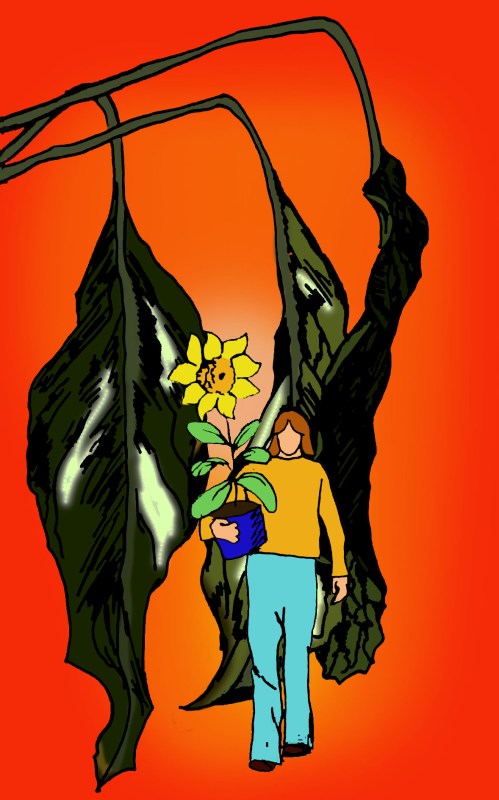
That needs water, Em says. In fact, they all do. I look up from my book and for the first time in who knows how long, to the pale, flaccid plants I live with. Later, when she is gone, I cart two large saucepans back and forth from the sink to the plants offering them drink until they are overflowing. There are several small waterfalls falling from the base of each plant and now I am running around salvaging what lies underneath them. I unplug cords and remove leather shoes and flap dry old magazines. There is an old Meajin with a post it note, which I have drawn an exclamation mark on. The dust on the magazine’s cover and the water have made a paste. The exclamation mark takes me to an article in which I have underlined a quote by Laurie Penny.
You see them everywhere, exhausted young women pouring all their spare energy into organising, encouraging and taking care of young men who resent them for doing it but resent them even harder when they don’t. You can fritter away the whole of your youth that way. I know women who have. I think that it’s usually better for women to be single. Particularly young women. Particularly straight young women. Not just “alright”. Not just “bearable” – actively better.
I close the magazine. There is a shallow layer of water in my bedroom, which makes my body erupt in a belly-genuine-laugh . There is nobody else around to tell me what to do next or take off my wet socks and hop in the shower. The magazine is dated twelve months ago when all the plants up here were happy and cared for, though, according to this magazine, I was not.
On the phone today, a woman asks me if this stuff even works. By stuff, she is referring to therapy. I tell her I think so, however everyone is different. The woman falls silent. Outside, beyond the thick sheet of glass that is the deli’s front window, the parking service assistant nods a smile to me. Before this morning, I wasn’t aware it is someone’s job to clean the inside of the parking meter. I watch him take a white cloth to the areas of the machine the coins move through so they do not end up on our hands all filthy. I wonder about the parking service assistant’s problems, if he is someone I might talk to on the phone during the day. This is how people appear to me now. After some consideration, the woman’s voice fills my ear again. But do you think it’d work for me?
Before embarking on Real Estate, I am re-reading the second book in Deborah’s trilogy, The Cost Of Living. I am in my new armchair and the book is more remarkable than I remember. There are underlines from when I read it two years ago, which is like having a conversation with a person who I only vaguely recognise. I go to my dresser for a pair of warm socks, the stripy ones made from Alpaca hair, and hear the roar of the football crowd at the Melbourne Cricket Ground. There are seagulls in the stadium lights. A siren sounds and the birds dart from their trajectories like a signature. Below, on the street, a man is walking from the car with six, maybe seven, pizza boxes.
It’s nine thirty, a Sunday, when Daisy ascends the stairs into my living space. She tells me she is early for work. I send the kettle to the boil, prepare two mugs for coffee and place a jar of Maltesers between us. Daisy is thumbing through the book I have left on the chair. I tell her to flick to page five, to where there is a passage I underlined when I first read The Cost Of Living two years ago, when I had not yet come up for air. I run my fingers along the tattoo of the flowers on my radius, which are glowing in this moment of sitting here waiting for Daisy to finish reading.
Deborah writes,
When love starts to crack the night comes in. It goes on and on. It is full of angry thoughts and accusations. These tormenting internal monologues don’t stop when the sun rises. This is what I resented most, that my mind had been abducted and was full of Him. It was nothing less than an occupation. My own unhappiness was starting to become a habit, in the way that Beckett described sorrow becoming a ‘thing you can keep adding to all your life…like a stamp or an egg collection’.
I take a Malteser and place it on my tongue. The chocolate thins in the heat of my mouth and the biscuit disintegrates. If it happened to Deborah and the young woman on the balcony and the young woman in this chair, perhaps my lecturer is not wrong, perhaps all of this is species typical after all. This thought is as reassuring as it is demoralising. I will never cover up the flowers along my radius. The flowers, I have decided, serve as a reminder of intuition, or better yet, what happens when one does not follow theirs.
 Yellow Days